休息过后,我们继续学习李邪为艺树人设计的Meyerhold的etude, “The Slap”。艺树人学会了Meyerhold的握手方式,还有准备给人一巴掌的姿势。从头练习整个etude是一件蛮辛苦的事,因为Meyerhold要求的准确性和我们平常不习惯的姿势使用的肌肉很少会被动用到。要不是这些etude,我想,这些肌肉差不多能说是永远都不会派上用场。
In our last lesson, ARTivate continued working on our otkaz, posil and stoica through games activities such as:
Throwing an increasing number of tennis balls across the room while moving in a random manner
Moving around the room in groups, with every change in direction effected by general consensus and not following a leader (as opposed to the “fish exercise”)
The game of laoyingzhuoxiaoji (“eagle and the chicken/chick”?) between each pair
Each ARTivator had to ensure that his/her actions are executed precisely so as to facilitate anticipation in the other parties.
We then practised our balancing skills, which consists of grouping our core muscles, the three principles listed above and switching of our tochka every step we take. Wooden cubes of the same size were placed in the middle of the room and every ARTivator had to cross the room by stepping on them, similar to crossing a river while stepping on stones. The distance between each cube was slowly increased and soon, even the size of the cubes was varied, and also the orientation of the cubes. Other requirements were added, such as rotating your upper body three times before crossing the “river” and spinning 360° before getting up a cube. All these little changes increased the difficulty at each stage but they were really simple activities that could keep us entertained.
We then continued learning Meyerhold’s etude, “The Slap”, as modified by Li Xie for the amateur ARTivators. From last week’s “greeting position”, we proceeded on to “greet” and “preparation to slap”. Revising these actions right from the start was really tiring. All the weird angles and the need for clean lines definitely put my lazy muscles to a good test.
We concluded the day by honing our balance with the help of bamboo poles. By balancing these poles on our palms, each ARTivators had to move around the room, meet up with a partner halfway through and even shift the poles from one palm to another. It certainly was no easy task moving around with a long extension from the middle of your palms but nonetheless, we enjoyed that activity very much.
Once again, the lesson ended on quite a good note, with it’s fair share of laughter and muscle aches (from staying in the same position while practising the etude). I’m definitely looking forward to learning the actual slap. *evil laughter*
Have you ever thought of doing your part for Mother Earth?
I've just heard from my friend this morning that Singapore Management University (SMU) is hosting a recycling drive by Nokia. From now till the end of November, simply drop off your old and unwanted Nokia mobile phones at SMU and you'll get to have a tree planted in YOUR name! The exact coordinates of the tree would be given so you can check the location of your tree on Google Maps/Earth.
Interested? You can probably find out more from your friends or make a trip down to the very accessible campus today!
Last week, the main part of the lesson is placed on the training of our legs and the flexibility of our body. The placement and position of our legs are very important in biomechanics because these are some of the factors affecting the weight shifting of our body. The weight shifting will actually affect the steadiness of our body in some way and that is what Li Xie has been emphasizing to us -- the importance of the steadiness of our body. On the other hand, our flexibility will affect the "shape" of our body when we do certain actions. Training of our legs is not as tired as it seem to be as Li Xie trained us using some fun exercises!
Still remember the games that we played when we were young? Catching was one of my favourite game then. Li Xie actually uses this game as part of our training! Everyone was excited when we knew that we are going to play that =) However, there are some rules and regulations that we need to follow. We are only allowed to move on one leg! But we can freeze ourselves and stay at the same spot if we are unable to escape in time. The purpose of having this "freeze" privilege is in fact one of the things that we had been trained on-- Thomoz. We have to learn to balance ourselves in all situations and identify the brake of our body. Sounds fun? It was indeed a fun game where everyone scream and run for their lives on one leg. It did not feel tiring at all until the game was stopped.I guess is really a good way to train our legs hee.
Prior to the catching game, we had some exercises to prepare ourselves for the game. We were asked to bend our knees and lowered our bodies to move across the space. We have to keep our bodies straight at the same time. This requires a lot effort from our leg as well.
我们也来跳 Hip Hop!
还记得每次看到舞蹈员跳 Hip Hop的其中一种舞步吗?就是蹲着,把其中一只脚伸直并把双手放在地上然后伸直的脚便会在地上旋转一圈。为了训练我们身体的灵活度,我们上个星期也练习了类似的动作。大家第一次尝试这样的动作难免看起来有点僵硬和笨拙但练习了几次大家便发现其实这个动作和我们之前学的很多动作一样,只要懂得运用otkaz就不会觉得那么吃力。
Still remember the dance movements by hip hop dances? Those movements where they will squat down with one leg straighten and both of their hands on the ground after which they will then spin their leg on the ground. We did a similar exercise to train the flexibility of our body. Of course, we are not able to do it as swiftly and nicely. But, once we identify the use of otkaz for the movement, things become much easier.
We were pair up at first for this exercise. Each pair had a pole and we were required to support the pole with one of our finger each while moving around in the room. We have to try to keep the pole in place and not let it dropped to the floor. It started off easy but as are asked to close our eyes, it became challenging. While we try to keep the pole in place, we are constantly shifting the weight of our body, hence we will naturally need to move our legs in a flexible way. We were later asked to form a group of 5. The increase number of people and poles requires more coordination of our body movement. Li xie added more conditions along the way and it challenges our body to be really flexible in order to complete the task without dropping the poles.
For the past few weeks, we had been learning how to walk, run and jump. Last week, we have finally proceed to shaking hands! This may sound weird to you, why do we need to learn how to shake hand? The biomechanics way of a hand shake is different from the normal ones that we have when we met someone that we just know. Like what Li Xie had been emphasizing, biomechanics is not a performing method, it is a form of actors training. So, regardless of what we learnt, we are in fact tuning our body in order to achieve the shape of the actions we are required to do. In other words, many actions in biomechanics challenge us to use different parts of our body that we do not usually use. Last week, we line up the jump and run actions together with the handshake that we just learnt into a sequence of movements. This sequence of movements is actually part of an etude that we are learning - the "Slap". If you are interest in finding out what is an etude, you may want t read up on books or check it out online. I am still learning along the way, so I shall not state my understanding of a etude here in any case if I mislead anyone.
Looking forward to the next lesson! Hope you guys will look forward to our next post too! See you!
Again, we were to find 20 directions/shapes of different body parts during the warm up. 2 additional things we had to look out for were the pre-planning of our next direction/shape as well as the emotion attached to it. I found it most fun to find 20 shapes for the body as it really challenged me to give it more possibilities.
With 2 people standing in the hoop, they take turns to push each other once in attempt to get the other party out of the hoop. The idea is to apply our brake (tomoz) and regain balance quickly, while using the push from the other party as an otkaz to return the energy.
After this exercise, the "playing field" was expanded to the entire rehearsal space and each were to push the other party to a point.
One important point to note is that the application of our centre (muscles around the stomach) is especially important in finding our balance. To show that, we were told to maintain at the mode of being "on the verge of falling" so that we can feel our muscles at the centre of our body tensed up in order to prevent the fall.
3. Shrinking Rectangle The original rectangle had 13 people in it. The crowdedness was comparable to that of the amk central crowd along the shophouses. we were told to walk in it (applying our tomoz) and not hitting anyone. As the rectangle "shrinks", the crowd becomes that of citylink on a public holiday, and gradually to that of orchard road on christmas eve. We were told to slow-mo our movements so that we are fully aware of our body.
using the exercise above, we were to push each other our of the rectangle! and MYRA emerged as the winner ahahah
4。跑/跳
注:
-用右脚来把自己“弹”上来
-跳完后手的位置
4. Run & Jump We finally learnt how to run and jump!
These were the main instructions:
preparation for running position
preparation for run
jumping to stop position (replaced by an "hurp" sound)
some notes here include beig aware of the "spring" on right foot and the position of hands after jump (hands should be "prepared" during jump)
Half the 136 youths arrested in past 12 months were students
STUDENTS made up almost half of the 136 youths arrested for loan-shark and related harassment activities in the past 12 months, said Education Minister Ng Eng Hen yesterday.
He also stressed that parents, as primary caregivers, are responsible for what their children do after school.
However, schools, playing a complementary role, have been actively taking measures to prevent them from taking part in illegal activities, he said in his written reply to a parliamentary question from Ms Lee Bee Wah (Ang Mo Kio GRC).
Ms Lee had asked how the ministry prevents youths from becoming runners for loan sharks.
Replying, Dr Ng stressed that parents must be responsible for monitoring their children's after-school activities, and the company they keep.
'The reasons for school children being lured into working for such activities are complex,' he said.
'Even as we reiterate the responsibility of parents to mould their children's character, schools can play a complementary reinforcing role in this respect.'
Dr Ng said schools raise awareness of illegal activities through formal curriculum, and hold programmes to help students discern right from wrong.
When necessary, counselling and support are offered, while disciplinary action is taken as a last resort.
Other efforts include keeping parents informed of their children's needs and collaborating with relevant agencies to guide students on the right path.
He cited how his ministry works with the police to raise awareness by giving advice, including at roadshows.
- Shared by a.Khl with love from UK
I saw the headlines that morning too but before I had time to sit down and read the article, I realised I was running late for school. Have we all become too preoccupied and hence apathetic towards the phenomena that are happening around us? I guess I sure am guilty of that sometimes.
It was our weekly Biomechanics lesson again! Seriously, I think these weekly lessons really make my life more interesting and it makes me do things I normally wouldn’t do during my day-to-day activities.
We started the day with the “Spider-Man” activity in which we gave most of our weight to our hands and arms and. Pushing our palms (and ourselves) away from the wall, we had to quickly contact the wall with our palms again somewhere further off such that we can move along the circumference of the room. The same principle was then applied to moving in a circle with the ARTivators standing in a circle and acting as the wall. However, this time, Newton’s third law became evident and each ARTivator would bend in the direction he/she is pushed, making it increasingly harder for the next person to move around especially when everyone started sitting or squatting on the floor.
We also learnt how to fall by “spiraling” down, using the principles of otkaz, posyl, and stoica. Then, applying these principles again, we played a game similar to dog-and-bone. ARTivators were split into two groups (one doing ‘defence’ while the other ‘attacks’) and each ARTivator from each group given a number. When a number is called, the two will run to the middle and the ‘defender’ will try to use his/her body to block the ‘attacker’ from crossing. This requires a clear otkaz and stoica so that one can anticipate and plan the next move. We also tried this without any eye contact, which makes the game even more challenging. Attempts to incorporate Bianco, Li Xie’s lovely white dog, gave us no joy though ):
Then, we worked with tomos, where the ARTivators sprinted from one end of the room to the other and braked just in front of the wall.
My favourite activity of the day was when we paired up and one partner would be under another’s control. Partner A would relax the muscles in his/her body and, subject to partner B’s pushing of varying strength and direction, move around the room or across the floor. It feels really good to have someone in control, to have someone think for you, and for once, you feel really free of all obligations.
Finally, we concluded the session learning one of Meyerhold’s étude, ‘The Slap’, but simplified by Li Xie. It was one of the most tiring thing of the day! The angled elbows and the twist of the torso - they never seemed that demanding. Meyerhold is definitely one fascinating man.
Wow. Looks like we’re learning more and more each week. Just look at the increasing length of each post!
This social dialogue is organised by com.passion.sg, a Singapore-based network aimed at practising compassion through reflection and social action.
Felicia Low is this year's President young talent(PYT) artist and arts educator.
During the social dialogue she shared with us her vision of social art, such as her project at H.O.M.E and her workshops at the prison. ("breaking" the system in these venues, as arts does not usually permeate there easily)
Felicia has been teaching for 10 years and doing community art for the recent 4-5 years.
She believes in doing things in public spaces, so as to allow the arts to reach out to people who seldom get in touch with it.
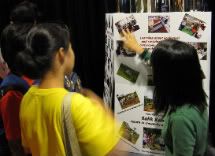
For this YPT exhibition at 8Q sam, she shared her arts process which investigates on the theme of ‘family’. She held workshops with 6 groups of people, all from different age groups. She chose these groups of people by herself. All the art works revolve around things that are most important/relevant to their lives. The public is also allowed to enter the gallery any time to contribute their art works onto the walls of the gallery. it has been around 2 months and the walls are already almost filled! the exhibition will still be on everyday till dec. do go and tk a look! (:
artwork by northlight school girls
haha see the merlion in there? :P
artwork by public
the seven deadly sins; gluttony (the colourful words say "i will not eat another ice cream" X ??? times)
artwork by public
Heavy school bags !
An "issue" mentioned during the dialogue was about the sustainability of the arts.
Felicia talked about her collaboration with Northlight school students are are currently doing vocational studies in cooking/culinary skills. this means that they will not be able to continue doing art for leisure as they will probably be working a lot after coming out of school.
I feel that this is quite applicable to all forms of arts and it is important(for myself at least) to keep this in mind when doing any community production.
For more info, check these out! (:
about the organiser: http://com.passion.sg
about PYT: http://pyt.sg/felicia.php
felicia low's official website: http://felicialow.com
I guess I have gotten use to the physical demands of our biomechanics lessons thus feeling less tired after the 3rd lesson. But I think the tiring part came in not just because of the physical demanding exercises but more of me not being able to internalize principle of biomechanics. Or perhaps, I didn't fully understand how to make use of my otkaz. haha not that I am an expert now, but I guess I am or rather all the artivators are beginning to have a better control of our body now as we gain the momentum.
Warm up~~
We were asked to find 20 directions of our neck and ankle during the warm up. I was a little confused at first but I realised it meant finding 20 different ways you can tilt your head and bend your ankle. To me, this exercise help us to explore the way our body can move and in a way enhance the flexibility of our body.
Becoming Kung Fu masters~
Later on we were asked to walk across the space with minimal noise. It reminded me of those Kung fu master that practically fly around!Of cause we are not doing that.. But anyway back to the topic, we were all swaying our hands and bending our knees as we tried to walk quickly and softly. These actions came naturally from us when we want to walk as swiftly and softly as possible.
Learning how to....WALK
We then walked around the space with these natural actions but not forgetting the otkaz, posyl and stoica. Besides walking back and fro, we also walk sideways. We were later asked to "draw" a star as we walked. It may seem to be an easy task but it was actually quite a challenge if you can't visualize the star that you are drawing. Yup I can't see my route very well, so my star was out of shaped T__T " I promise I will improve on this.
Other than all these, we did some other small exercises as well =) Looking forward to the next lesson! Look out for our next post to know more about what we learn!
Basically for the individual part of the exercise, it is to throw the ball from one hand and catch it with another. this involves the shifting of your weight from one foot to the another.
Next we had to move across the space while tossing the ball forward and catching it. we tried with different number of throws (ie. 1 throw across the space). this involves estimation of otkaz
注 notes:
- focus on ball and go with its flow 集中在球上,跟着它的“流程”
- when otkaz, posyl and stoica are correctly applied, there is a rhythm to the movement and it becomes alot easier ! 使用otkaz, posyl 和 stoica,可让动作更容易做出来,因为有节奏。
- when shifting balance from one foot to another, make sure the "weightless" foot is turn inwards so that we do not put stress on it. 把没有在使力的脚往内侧
- a slight tipping of toe during posyl helps when shifting weight 边移中心点,边提脚尖
- mathematics is important in gauging the distance travelled per throw! 用数学来预测每次扔球,自己需要走多少!
-plan your otkaz
4. Tennis ball exercise (partner work) 网球活动(二人)
两人一面传球给对方,一起穿过空间。
for this exercise each pair has to move across the space by passing the ball to each other.
throw, stop, move(together as a pair). repeat movement till we got to the other side.
notes:
-focus and communication between partners are important 集中和沟通很重要
-clear otkaz helps to signal movement. 清楚的otkaz可以帮忙给另一个人要移动提示
It was ARTivate’s first physically-demanding lesson since CityS concluded two months ago and most of us have not been doing much exercise regularly during this period! So while we were all really excited over the start of our Biomechanics lessons with a new (to us) instructor, Li Xie, I was a little apprehensive. After all, the name ‘Biomechanics’ itself seems to suggest something really demanding, something to do with machines or mechanical movements, which obviously are not acts of a normal human on normal days.
ARTivate decided to start the day with the set of warm-up exercises taught by Wan Ching during CityS. Li Xie then showed us a brief video on the history of Biomechanics and its possibilities, such as helping actors explore the theatrical space.
Next, we embarked on a series of activities which got us moving across the space on our palms and feet, using the amazing otkaz, whereby one draws strength from a previous action to perform a following action with much less energy than would be required. (Disclaimer: This is NOT a reliable definition!)
We also did some exercises which required us to balance ONLY on our bottom (i.e. it requires a lot of abdominal strength) and I almost died with my lack of abs ): By means of waving our limbs frantically, we were supposed to rotate a full 360° on the spot, with our bottoms never leaving the ground and our limbs never touching the ground. Everyone simply looked HILARIOUS!
All in all, I truly enjoyed our first Biomechanics lesson by Li Xie. I hope the next one this coming Saturday would be just as enjoyable too, if not more! I guess it’s time I start doing some light exercises again and break out of the monotony of school. Till then!
(P.S. You might want to google Biomechanics by Meyerhold for more information. Enjoy!)
This video that I am sharing with everyone is a commentary on Malaysian Censorship Laws. It is not only amusing but a very creative way to discuss about a sensitive topic in the nation.
Do take some time to watch it. You will be amused by the lady in the video. She is classic
ARTivate is the youth wing of Drama Box, launched in May 2007. It is made up of a group of passionate youths who aims to reach out to the larger community through the arts.
ARTivate aims to nurture this new group of youths into cultured and socially aware theatre-practitioners in Singapore. ARTivate also offers a career choice in the industry over time.
ARTivate uses the O-A-O-R (Orientation-Artistic-Organization-Regeneration) pedagogy and the youths are trained not only artistically but also in organizational skills. They undergo training in theatre skills (such as Forum Theatre, Newspaper Theatre, Production Management etc), other art forms such as music, film, multimedia, as well as principles of leadership, management and organization. They will put these skills to test by managing their own teams.
Each year, they will collaborate with at least one underprivileged group to create works/projects. These projects may help to generate income (in support of the project and ARTivate).
Through such collaborations, they hope to change the mindsets of both the general public and the disadvantaged groups, thus moving them from monologues into dialogues with one other.
*The workshop/courses are conducted mainly in Mandarin.
许慧铃 Koh Hui Ling 艺术总监 Artistic Director
母性泛滥; 热爱人
着重于戏剧/剧场的应用与教学法
Overpowering maternal instincts
Loves Human(ity)
Aims at developing the use of applied drama / theatre
休息过后,我们继续学习李邪为艺树人设计的Meyerhold的etude, “The Slap”。艺树人学会了Meyerhold的握手方式,还有准备给人一巴掌的姿势。从头练习整个etude是一件蛮辛苦的事,因为Meyerhold要求的准确性和我们平常不习惯的姿势使用的肌肉很少会被动用到。要不是这些etude,我想,这些肌肉差不多能说是永远都不会派上用场。
In our last lesson, ARTivate continued working on our otkaz, posil and stoica through games activities such as:
Throwing an increasing number of tennis balls across the room while moving in a random manner
Moving around the room in groups, with every change in direction effected by general consensus and not following a leader (as opposed to the “fish exercise”)
The game of laoyingzhuoxiaoji (“eagle and the chicken/chick”?) between each pair
Each ARTivator had to ensure that his/her actions are executed precisely so as to facilitate anticipation in the other parties.
We then practised our balancing skills, which consists of grouping our core muscles, the three principles listed above and switching of our tochka every step we take. Wooden cubes of the same size were placed in the middle of the room and every ARTivator had to cross the room by stepping on them, similar to crossing a river while stepping on stones. The distance between each cube was slowly increased and soon, even the size of the cubes was varied, and also the orientation of the cubes. Other requirements were added, such as rotating your upper body three times before crossing the “river” and spinning 360° before getting up a cube. All these little changes increased the difficulty at each stage but they were really simple activities that could keep us entertained.
We then continued learning Meyerhold’s etude, “The Slap”, as modified by Li Xie for the amateur ARTivators. From last week’s “greeting position”, we proceeded on to “greet” and “preparation to slap”. Revising these actions right from the start was really tiring. All the weird angles and the need for clean lines definitely put my lazy muscles to a good test.
We concluded the day by honing our balance with the help of bamboo poles. By balancing these poles on our palms, each ARTivators had to move around the room, meet up with a partner halfway through and even shift the poles from one palm to another. It certainly was no easy task moving around with a long extension from the middle of your palms but nonetheless, we enjoyed that activity very much.
Once again, the lesson ended on quite a good note, with it’s fair share of laughter and muscle aches (from staying in the same position while practising the etude). I’m definitely looking forward to learning the actual slap. *evil laughter*
Have you ever thought of doing your part for Mother Earth?
I've just heard from my friend this morning that Singapore Management University (SMU) is hosting a recycling drive by Nokia. From now till the end of November, simply drop off your old and unwanted Nokia mobile phones at SMU and you'll get to have a tree planted in YOUR name! The exact coordinates of the tree would be given so you can check the location of your tree on Google Maps/Earth.
Interested? You can probably find out more from your friends or make a trip down to the very accessible campus today!
Last week, the main part of the lesson is placed on the training of our legs and the flexibility of our body. The placement and position of our legs are very important in biomechanics because these are some of the factors affecting the weight shifting of our body. The weight shifting will actually affect the steadiness of our body in some way and that is what Li Xie has been emphasizing to us -- the importance of the steadiness of our body. On the other hand, our flexibility will affect the "shape" of our body when we do certain actions. Training of our legs is not as tired as it seem to be as Li Xie trained us using some fun exercises!
Still remember the games that we played when we were young? Catching was one of my favourite game then. Li Xie actually uses this game as part of our training! Everyone was excited when we knew that we are going to play that =) However, there are some rules and regulations that we need to follow. We are only allowed to move on one leg! But we can freeze ourselves and stay at the same spot if we are unable to escape in time. The purpose of having this "freeze" privilege is in fact one of the things that we had been trained on-- Thomoz. We have to learn to balance ourselves in all situations and identify the brake of our body. Sounds fun? It was indeed a fun game where everyone scream and run for their lives on one leg. It did not feel tiring at all until the game was stopped.I guess is really a good way to train our legs hee.
Prior to the catching game, we had some exercises to prepare ourselves for the game. We were asked to bend our knees and lowered our bodies to move across the space. We have to keep our bodies straight at the same time. This requires a lot effort from our leg as well.
我们也来跳 Hip Hop!
还记得每次看到舞蹈员跳 Hip Hop的其中一种舞步吗?就是蹲着,把其中一只脚伸直并把双手放在地上然后伸直的脚便会在地上旋转一圈。为了训练我们身体的灵活度,我们上个星期也练习了类似的动作。大家第一次尝试这样的动作难免看起来有点僵硬和笨拙但练习了几次大家便发现其实这个动作和我们之前学的很多动作一样,只要懂得运用otkaz就不会觉得那么吃力。
Still remember the dance movements by hip hop dances? Those movements where they will squat down with one leg straighten and both of their hands on the ground after which they will then spin their leg on the ground. We did a similar exercise to train the flexibility of our body. Of course, we are not able to do it as swiftly and nicely. But, once we identify the use of otkaz for the movement, things become much easier.
We were pair up at first for this exercise. Each pair had a pole and we were required to support the pole with one of our finger each while moving around in the room. We have to try to keep the pole in place and not let it dropped to the floor. It started off easy but as are asked to close our eyes, it became challenging. While we try to keep the pole in place, we are constantly shifting the weight of our body, hence we will naturally need to move our legs in a flexible way. We were later asked to form a group of 5. The increase number of people and poles requires more coordination of our body movement. Li xie added more conditions along the way and it challenges our body to be really flexible in order to complete the task without dropping the poles.
For the past few weeks, we had been learning how to walk, run and jump. Last week, we have finally proceed to shaking hands! This may sound weird to you, why do we need to learn how to shake hand? The biomechanics way of a hand shake is different from the normal ones that we have when we met someone that we just know. Like what Li Xie had been emphasizing, biomechanics is not a performing method, it is a form of actors training. So, regardless of what we learnt, we are in fact tuning our body in order to achieve the shape of the actions we are required to do. In other words, many actions in biomechanics challenge us to use different parts of our body that we do not usually use. Last week, we line up the jump and run actions together with the handshake that we just learnt into a sequence of movements. This sequence of movements is actually part of an etude that we are learning - the "Slap". If you are interest in finding out what is an etude, you may want t read up on books or check it out online. I am still learning along the way, so I shall not state my understanding of a etude here in any case if I mislead anyone.
Looking forward to the next lesson! Hope you guys will look forward to our next post too! See you!
Again, we were to find 20 directions/shapes of different body parts during the warm up. 2 additional things we had to look out for were the pre-planning of our next direction/shape as well as the emotion attached to it. I found it most fun to find 20 shapes for the body as it really challenged me to give it more possibilities.
With 2 people standing in the hoop, they take turns to push each other once in attempt to get the other party out of the hoop. The idea is to apply our brake (tomoz) and regain balance quickly, while using the push from the other party as an otkaz to return the energy.
After this exercise, the "playing field" was expanded to the entire rehearsal space and each were to push the other party to a point.
One important point to note is that the application of our centre (muscles around the stomach) is especially important in finding our balance. To show that, we were told to maintain at the mode of being "on the verge of falling" so that we can feel our muscles at the centre of our body tensed up in order to prevent the fall.
3. Shrinking Rectangle The original rectangle had 13 people in it. The crowdedness was comparable to that of the amk central crowd along the shophouses. we were told to walk in it (applying our tomoz) and not hitting anyone. As the rectangle "shrinks", the crowd becomes that of citylink on a public holiday, and gradually to that of orchard road on christmas eve. We were told to slow-mo our movements so that we are fully aware of our body.
using the exercise above, we were to push each other our of the rectangle! and MYRA emerged as the winner ahahah
4。跑/跳
注:
-用右脚来把自己“弹”上来
-跳完后手的位置
4. Run & Jump We finally learnt how to run and jump!
These were the main instructions:
preparation for running position
preparation for run
jumping to stop position (replaced by an "hurp" sound)
some notes here include beig aware of the "spring" on right foot and the position of hands after jump (hands should be "prepared" during jump)
Half the 136 youths arrested in past 12 months were students
STUDENTS made up almost half of the 136 youths arrested for loan-shark and related harassment activities in the past 12 months, said Education Minister Ng Eng Hen yesterday.
He also stressed that parents, as primary caregivers, are responsible for what their children do after school.
However, schools, playing a complementary role, have been actively taking measures to prevent them from taking part in illegal activities, he said in his written reply to a parliamentary question from Ms Lee Bee Wah (Ang Mo Kio GRC).
Ms Lee had asked how the ministry prevents youths from becoming runners for loan sharks.
Replying, Dr Ng stressed that parents must be responsible for monitoring their children's after-school activities, and the company they keep.
'The reasons for school children being lured into working for such activities are complex,' he said.
'Even as we reiterate the responsibility of parents to mould their children's character, schools can play a complementary reinforcing role in this respect.'
Dr Ng said schools raise awareness of illegal activities through formal curriculum, and hold programmes to help students discern right from wrong.
When necessary, counselling and support are offered, while disciplinary action is taken as a last resort.
Other efforts include keeping parents informed of their children's needs and collaborating with relevant agencies to guide students on the right path.
He cited how his ministry works with the police to raise awareness by giving advice, including at roadshows.
- Shared by a.Khl with love from UK
I saw the headlines that morning too but before I had time to sit down and read the article, I realised I was running late for school. Have we all become too preoccupied and hence apathetic towards the phenomena that are happening around us? I guess I sure am guilty of that sometimes.
It was our weekly Biomechanics lesson again! Seriously, I think these weekly lessons really make my life more interesting and it makes me do things I normally wouldn’t do during my day-to-day activities.
We started the day with the “Spider-Man” activity in which we gave most of our weight to our hands and arms and. Pushing our palms (and ourselves) away from the wall, we had to quickly contact the wall with our palms again somewhere further off such that we can move along the circumference of the room. The same principle was then applied to moving in a circle with the ARTivators standing in a circle and acting as the wall. However, this time, Newton’s third law became evident and each ARTivator would bend in the direction he/she is pushed, making it increasingly harder for the next person to move around especially when everyone started sitting or squatting on the floor.
We also learnt how to fall by “spiraling” down, using the principles of otkaz, posyl, and stoica. Then, applying these principles again, we played a game similar to dog-and-bone. ARTivators were split into two groups (one doing ‘defence’ while the other ‘attacks’) and each ARTivator from each group given a number. When a number is called, the two will run to the middle and the ‘defender’ will try to use his/her body to block the ‘attacker’ from crossing. This requires a clear otkaz and stoica so that one can anticipate and plan the next move. We also tried this without any eye contact, which makes the game even more challenging. Attempts to incorporate Bianco, Li Xie’s lovely white dog, gave us no joy though ):
Then, we worked with tomos, where the ARTivators sprinted from one end of the room to the other and braked just in front of the wall.
My favourite activity of the day was when we paired up and one partner would be under another’s control. Partner A would relax the muscles in his/her body and, subject to partner B’s pushing of varying strength and direction, move around the room or across the floor. It feels really good to have someone in control, to have someone think for you, and for once, you feel really free of all obligations.
Finally, we concluded the session learning one of Meyerhold’s étude, ‘The Slap’, but simplified by Li Xie. It was one of the most tiring thing of the day! The angled elbows and the twist of the torso - they never seemed that demanding. Meyerhold is definitely one fascinating man.
Wow. Looks like we’re learning more and more each week. Just look at the increasing length of each post!
This social dialogue is organised by com.passion.sg, a Singapore-based network aimed at practising compassion through reflection and social action.
Felicia Low is this year's President young talent(PYT) artist and arts educator.
During the social dialogue she shared with us her vision of social art, such as her project at H.O.M.E and her workshops at the prison. ("breaking" the system in these venues, as arts does not usually permeate there easily)
Felicia has been teaching for 10 years and doing community art for the recent 4-5 years.
She believes in doing things in public spaces, so as to allow the arts to reach out to people who seldom get in touch with it.
For this YPT exhibition at 8Q sam, she shared her arts process which investigates on the theme of ‘family’. She held workshops with 6 groups of people, all from different age groups. She chose these groups of people by herself. All the art works revolve around things that are most important/relevant to their lives. The public is also allowed to enter the gallery any time to contribute their art works onto the walls of the gallery. it has been around 2 months and the walls are already almost filled! the exhibition will still be on everyday till dec. do go and tk a look! (:
artwork by northlight school girls
haha see the merlion in there? :P
artwork by public
the seven deadly sins; gluttony (the colourful words say "i will not eat another ice cream" X ??? times)
artwork by public
Heavy school bags !
An "issue" mentioned during the dialogue was about the sustainability of the arts.
Felicia talked about her collaboration with Northlight school students are are currently doing vocational studies in cooking/culinary skills. this means that they will not be able to continue doing art for leisure as they will probably be working a lot after coming out of school.
I feel that this is quite applicable to all forms of arts and it is important(for myself at least) to keep this in mind when doing any community production.
For more info, check these out! (:
about the organiser: http://com.passion.sg
about PYT: http://pyt.sg/felicia.php
felicia low's official website: http://felicialow.com
I guess I have gotten use to the physical demands of our biomechanics lessons thus feeling less tired after the 3rd lesson. But I think the tiring part came in not just because of the physical demanding exercises but more of me not being able to internalize principle of biomechanics. Or perhaps, I didn't fully understand how to make use of my otkaz. haha not that I am an expert now, but I guess I am or rather all the artivators are beginning to have a better control of our body now as we gain the momentum.
Warm up~~
We were asked to find 20 directions of our neck and ankle during the warm up. I was a little confused at first but I realised it meant finding 20 different ways you can tilt your head and bend your ankle. To me, this exercise help us to explore the way our body can move and in a way enhance the flexibility of our body.
Becoming Kung Fu masters~
Later on we were asked to walk across the space with minimal noise. It reminded me of those Kung fu master that practically fly around!Of cause we are not doing that.. But anyway back to the topic, we were all swaying our hands and bending our knees as we tried to walk quickly and softly. These actions came naturally from us when we want to walk as swiftly and softly as possible.
Learning how to....WALK
We then walked around the space with these natural actions but not forgetting the otkaz, posyl and stoica. Besides walking back and fro, we also walk sideways. We were later asked to "draw" a star as we walked. It may seem to be an easy task but it was actually quite a challenge if you can't visualize the star that you are drawing. Yup I can't see my route very well, so my star was out of shaped T__T " I promise I will improve on this.
Other than all these, we did some other small exercises as well =) Looking forward to the next lesson! Look out for our next post to know more about what we learn!
Basically for the individual part of the exercise, it is to throw the ball from one hand and catch it with another. this involves the shifting of your weight from one foot to the another.
Next we had to move across the space while tossing the ball forward and catching it. we tried with different number of throws (ie. 1 throw across the space). this involves estimation of otkaz
注 notes:
- focus on ball and go with its flow 集中在球上,跟着它的“流程”
- when otkaz, posyl and stoica are correctly applied, there is a rhythm to the movement and it becomes alot easier ! 使用otkaz, posyl 和 stoica,可让动作更容易做出来,因为有节奏。
- when shifting balance from one foot to another, make sure the "weightless" foot is turn inwards so that we do not put stress on it. 把没有在使力的脚往内侧
- a slight tipping of toe during posyl helps when shifting weight 边移中心点,边提脚尖
- mathematics is important in gauging the distance travelled per throw! 用数学来预测每次扔球,自己需要走多少!
-plan your otkaz
4. Tennis ball exercise (partner work) 网球活动(二人)
两人一面传球给对方,一起穿过空间。
for this exercise each pair has to move across the space by passing the ball to each other.
throw, stop, move(together as a pair). repeat movement till we got to the other side.
notes:
-focus and communication between partners are important 集中和沟通很重要
-clear otkaz helps to signal movement. 清楚的otkaz可以帮忙给另一个人要移动提示
It was ARTivate’s first physically-demanding lesson since CityS concluded two months ago and most of us have not been doing much exercise regularly during this period! So while we were all really excited over the start of our Biomechanics lessons with a new (to us) instructor, Li Xie, I was a little apprehensive. After all, the name ‘Biomechanics’ itself seems to suggest something really demanding, something to do with machines or mechanical movements, which obviously are not acts of a normal human on normal days.
ARTivate decided to start the day with the set of warm-up exercises taught by Wan Ching during CityS. Li Xie then showed us a brief video on the history of Biomechanics and its possibilities, such as helping actors explore the theatrical space.
Next, we embarked on a series of activities which got us moving across the space on our palms and feet, using the amazing otkaz, whereby one draws strength from a previous action to perform a following action with much less energy than would be required. (Disclaimer: This is NOT a reliable definition!)
We also did some exercises which required us to balance ONLY on our bottom (i.e. it requires a lot of abdominal strength) and I almost died with my lack of abs ): By means of waving our limbs frantically, we were supposed to rotate a full 360° on the spot, with our bottoms never leaving the ground and our limbs never touching the ground. Everyone simply looked HILARIOUS!
All in all, I truly enjoyed our first Biomechanics lesson by Li Xie. I hope the next one this coming Saturday would be just as enjoyable too, if not more! I guess it’s time I start doing some light exercises again and break out of the monotony of school. Till then!
(P.S. You might want to google Biomechanics by Meyerhold for more information. Enjoy!)
This video that I am sharing with everyone is a commentary on Malaysian Censorship Laws. It is not only amusing but a very creative way to discuss about a sensitive topic in the nation.
Do take some time to watch it. You will be amused by the lady in the video. She is classic
The Green Man is part of Drama Box’s community project on Environment.
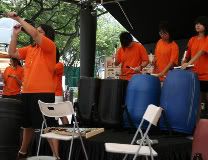
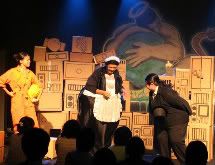
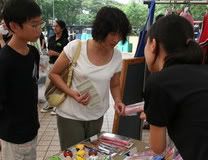
Conceptualized and organized by ARTivate, the event consists of:
- ARTivate’s thought-provoking plays on environmental conservation
- “The Flames” musical performance by girls from Andrew & Grace Home
- A mini bazaar that promotes environmental conservation
Selfish, written by Lam Dan Fong, reveals a story about the decision of a daughter -
to escape into a perfect new world or remain in the world of self destruction.
Plasti-City Kills the Cat written by Ho Kian Tong, explores the harm brought about by plastics to the environment.
What Matters? is a package of one forum theatre play and three fringe activities which explores the issue of race with the youths of today.
Through the series of fringe activities and the Forum Theatre play, ARTivate aims to probe further into the awareness of racial issues with the youths of today and understand the true meaning of harmony between races.
Forum Theatre Play
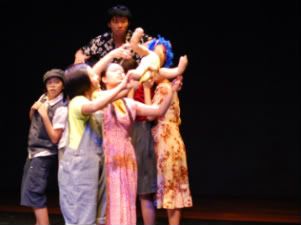
3 students of different races set up an Adventure Club in school. As they prepare to go on a new adventure to search for fugitive Mas Selamat in their club room, an accident happened in the school and conflicts arose within the group.
*The play is performed mainly in English with some Mandarin and Malay
Fringe #1: Race in School – Stereotypes and Others
The youths were asked to move, play, think and discover, thus finding the way of dealing with racial issues in real life.
Fringe #2: Movie screening – To Kill a Mocking bird
Based on the novel by Harper Lee, this award-winning classic film present racial issues vividly on screen.
There was a discussion session after the screening facilitated by Mr. Danny Yeo.
Sharing by young actors of Class Enemy from Bosnia
Fringe #3: Survival Ethnic Conflicts in Bosnia – a Singapore Arts Festival programme
Sharing by young actors of Class Enemy from Bosnia on their personal experiences of the war-torn times and how they have learnt to cope with growing up in an environment filled with violence caused by racial and ethnic conflicts.
Speaker: Director Haris Pasovic and the cast of CLASS ENEMY (East West Theatre Company)
The Movie Screening is the second installment of Project Mending Sky: The Green Man, held in conjunction with Project Mending Sky: ME (补天计划之我).
Through movie screenings and post-movie discussion sessions ARTivate hopes to explore issues surrounding our Earth’s survival amidst the damages we are inflicting on her.
Documentary-Movie #1: Winged Migration
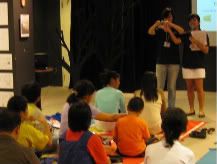
Teaching the audience how to make dustbins using flyers
Directed by Jacques Perrin, a noted actor and film producer in France, this Academy Award nominated movie records the flight of dozens of different birds from around the globe as they follow their navigational instincts and make the taxing journey to more temperate climates in the fall.
Documentary -Movie #2: The Greening of Cuba
Cuban farmers and scientists working to reinvent a sustainable agriculture based on ecological principles and local knowledge rather than imported agricultural inputs which remind us that developed and developing nations alike can choose a healthier environment and still feed their people.
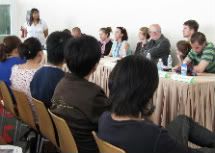
The audience sharing
Documentary -Movie #3: The Power of Community
A follow-up to The Greening of Cuba 10 years later to see how the Cuban transitioned from a highly mechanized, industrial agricultural system to one using organic methods of farming and local, urban gardens.
Discussions facilitated by: Mr Danny Yeo and Mr Tay Lai Hock
*Language: English (with English subtitles)
Part of a double-bill during Singapore Drama Educators Association (SDEA) Celebrate Drama 2009
“CityS” is ARTivate’s first devised play. It is also ARTivate’s debut presentation following a year-round capacity-building process, during which the ARTivators underwent a series of training involving acting and playwrighting.
It is conceived and brought to satisfactory theatrical fruition by the collaboration of all ARTivators via a gradual process and accumulation of brainstorming and improvisation, under the guidance of devising facilitator Kok Heng Leun and director Koh Wan Ching.
“CityS” explores the concept of an inclusive city, in Singapore’s context, and in the context of our current highly integrated, globalised world.
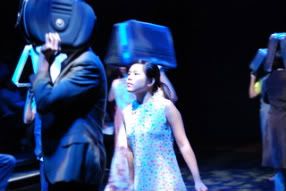
In this play, stories from different aspects of a city are connected by a series of luggage sonatas which symbolizes a journey that questions the ideology constructed and perceived by majority of the society. Realities are confronted: autocracy, disharmony, discrimination, limitations, alienation, oppression and the likes. Does the decision of the majority always account for the minority? Will the elites ever consider the welfare of their downtown folks in this race to the top? Is that action you took out of free will or under the influence of others?
ARTivate hopes that audiences will reconsider the meaning of a truly inclusive city after watching the play and in turn, answer these questions for themselves.
Devised and performed by ARTivate Devising facilitated by Kok Heng Leun Directed by Koh Wan Ching
*Performed mainly in Mandarin. (English Surtitles provided)
Drama Box is Singapore's most prominent contemporary Mandarin theatre company. It is a professional non-profit company with charity status. Formed in 1990, it has since gained a respectable reputation for its acute sensitivity and perception in heightening social awareness and civic responsibility. Our productions remain fun and entertaining, yet thought-provoking and reflective.
Blanc Space
The Blanc Space was inaugurated in 2000 to provide a training platform for performers. In 2007, the company expanded Blanc Space to include programmes for budding directors and aspiring playwrights.